引線二元樹 (Threaded Binary Tree)
My vault 資料結構筆記:引線二元樹 (Threaded Binary Tree)。
✅ 背景說明
普通的二元樹有以下性質:
-
有 $n$ 個節點,就有 $n−1$ 條實際存在的 child links(邊)。
-
若每個節點使用指標儲存左右子節點,則需要 $2n$ 個指標。
-
==其中會有:$2n - (n - 1) = n + 1$ 個是
null指標(空指標)。==
👉 這些空指標可以被有效利用來儲存「中序遍檢順序下的先行者與後繼者」。
📌 中序線索二元樹規則(Threading Rules)
-
若某節點的左子樹為空,則其
left指標指向 先行者(predecessor)。 -
若某節點的右子樹為空,則其
right指標指向 **後繼者(successor)。
📆 Thread Binary Tree 節點結構
 ┌───────────────┬────────┬──────┬────────┬──────────────┐
 │  leaftthread  │ Lchild │ Data │ Rchild │ rightthread  │
 │     (bool)    │        │      │        │    (bool)    │
 └───────────────┴────────┴──────┴────────┴──────────────┘
使用額外兩個布林變數 Lthread 和 Rthread 來區分指標是「真實子節點」還是「線索」。
struct ThreadNode {
    bool Lthread;          // True 表示 Lchild 是線索(非真子節點)
    ThreadNode* Lchild;

    int Data;

    ThreadNode* Rchild;
    bool Rthread;          // True 表示 Rchild 是線索(非真子節點)
};
判斷規則:
-
若
Lthread == false,代表Lchild是左子樹。 -
若
Lthread == true,代表Lchild是先行者。 -
同理,
Rthread == true表示Rchild是後繼者。
🔧 Head 節點(特殊節點)
Thread Binary Tree 中的 Head 節點具有特殊意義,負責協助非遞迴中序遍歷的開始與結束判斷。
🔸 Case 1:空樹(empty)
若樹為空,Head 節點會指向自己:
Lthread = True          Rthread = False
     ↓                        ↓
 ┌────────┬────────┬──────┬────────┬────────┐
 │ True   │ Lchild │ Data │ Rchild │ False  │
 │        │   ↑    │      │   ↓    │        │
 └────────┴────────┴──────┴────────┴────────┘
          ↖───────────────┘
-
Lchild和Rchild都指回自己(Head)。 -
Lthread = True表示Lchild是線索(不是左子樹)。
🔸 Case 2:非空樹(not empty)
若樹非空,Head 節點會指向實際的根節點:
Lthread = False         Rthread = False
     ↓                        ↓
 ┌────────┬────────┬──────┬────────┬────────┐
 │ False  │ Lchild │ Data │ Rchild │ False  │
 │        │   ↓    │      │        │        │
 └────────┴────────┴──────┴────────┴────────┘
          ↓
        root
-
Lchild指向整棵線索樹的根節點。 -
中序最左節點的前驅與最右節點的後繼會分別線索回 Head 節點。
完整示意圖
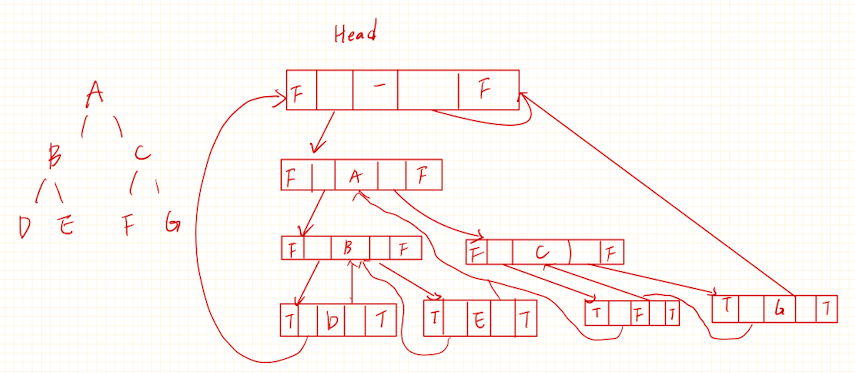
📈 優點與用途
-
可進行 非遞迴的中序遍檢,不需使用額外 stack。
-
節省記憶體(充分利用原本的 null 指標)。
-
適合查找與遍檢頻繁的場景,如資料庫索引結構等。
🔄 中序後繼與中序遍歷(C++)
✅ 中序後繼函式 Insuc
ThreadNode* Insuc(ThreadNode* x) {
    ThreadNode* temp = x->Rchild;

    // 如果 Rthread == false,代表 x 有右子樹
    // 需要往右子樹中最左側節點尋找中序後繼
    if (x->Rthread == false) {
        // 沿著左子樹往下找,直到找到線索節點(即最左節點)
        while (temp->Lthread == false) {
            temp = temp->Lchild;
        }
    }

    return temp; // 若 x 是中序最後一個節點,這裡可能會回傳 head
}
✅ 非遞迴中序遍歷 InorderTraversal
void InorderTraversal(ThreadNode* head) {
    ThreadNode* temp = head;

    do {
        temp = Insuc(temp);
        if (temp != head)
            std::cout << temp->Data << " ";
    } while (temp != head);
}
📘 補充說明
-
若某節點
x的Rthread == false,代表Rchild是右子樹,要往該子樹中最左節點找中序後繼。 -
若
Rthread == true,則Rchild已直接是中序後繼節點。 -
head是特殊的「頭節點」,用來標示起點與終點。
- 時間複雜度:每個節點都恰好拜訪一次 $O(N)$ ,中序遍歷不需要使用遞迴或額外 stack。
🧐 圖解說明
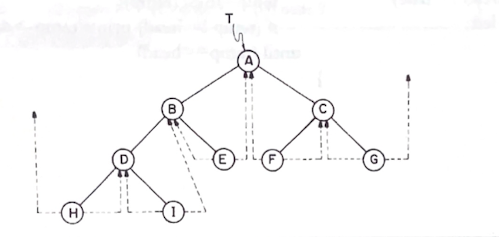
以下是圖中的二元樹中序遍檢順序:
$H \rightarrow D \rightarrow I \rightarrow B \rightarrow E \rightarrow A \rightarrow F \rightarrow C \rightarrow G \rightarrow head$
引線二元樹插入右子
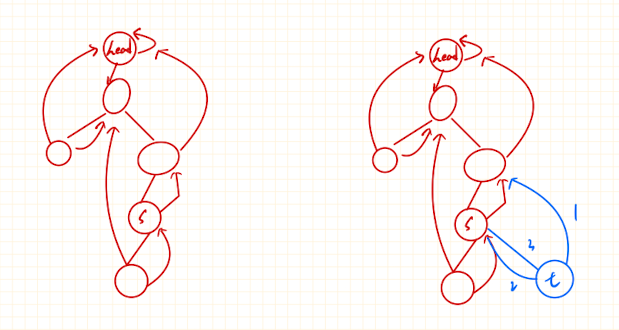
Case 1:S 原本沒有右子樹(S.Rthread == true)
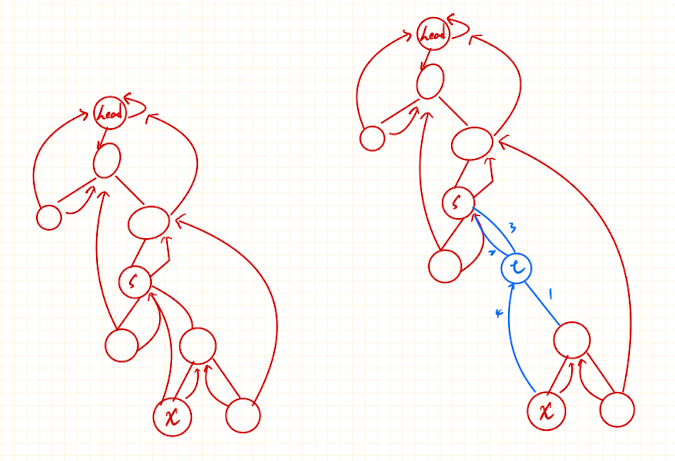
Case 2:S 原本有右子樹(S.Rthread == false)
實作程式碼
下面的程式碼依據中的 ①…⑤ 步驟編號對應:
void InsertRight(ThreadNode* S, ThreadNode* t) {
    // ① 複製 S 的原右線索到 t
    t->Rthread = S->Rthread;
    t->Rchild  = S->Rchild;

    // ② 設定 t 的左線索為指向 S(先行者)
    t->Lthread = true;
    t->Lchild  = S;

    // ③ 把 t 掛為 S 的右子節點
    S->Rchild  = t;
    S->Rthread = false;

    // ④ 若 t 繼承到的是一棵真右子樹(原 S 有右子樹)
    if (!t->Rthread) {
        // ⑤ 找到原右子樹的最左節點 p,修正其先行者線索到 t
        ThreadNode* p = t->Rchild;
        while (!p->Lthread) {
            p = p->Lchild;
        }
        p->Lchild = t;
    }
}
-
S 無右子樹 時(原本
S.Rthread == true)-
①、②:先把 S 的後繼線索複製到 t,並讓 t 指回 S 作為先行者。
-
③:把 t 掛為 S 的右子節點,並將
S.Rthread = false。 -
因為原 S 沒有真右子樹,④ 條件不成立,不用做後續修正。
-
-
S 有右子樹 時(原本
S.Rthread == false)-
①~③:流程同上,先複製線索、掛載 t。
-
④~⑤:因為繼承到的是一棵真右子樹,必須往該子樹最左邊一路走到底,找到節點
p,再把p->Lchild設為t,維持中序先行者正確。
-
Note: 若要將 T 插入 S 的左邊,將上述步驟中:
left/right意義互換
Insuc(t)改為Inpre(t)即可完成左插操作。